
“Space, no longer a distant dream but a future that India is actively building.” It is a rapidly evolving field in today’s world, and as India strengthens its position on the global space stage, exciting opportunities are opening up for students of this generation. One such defining step is Gaganyaan, ISRO’s lesser-known yet extremely critical mission.
At “Space India”, the Space Astronomy Club session “Rocketry”, introduces students to the fundamentals of rocketry, helping them understand rocket parts, functions, and flight principles. Students design and build their own hydro rockets, test them using a special launcher, and explore the key elements required for stable flight. Through hands-on learning, the sessions nurture curiosity, logical thinking, and a problem-solving mindset—instilling scientific temper and inspiring students to grow into amateur astronomers and budding space scientists.
To send a satellite in space is an engineering challenge but sending humans in space is a responsibility of bringing them back safely. ISRO’s Gaganyaan mission is India’s first mission to send humans in space and to bring them back safely. Every component of this mission, from launch vehicle to parachute is designed and tested by keeping only one thing in mind: “Safety”.
What is Gaganyaan?
Gaganyaan is a Sanskrit word meaning “Sky-Vehicle”. It is India’s first human spaceflight program led by Indian Space Research Organisation (ISRO). The aim of this mission is to send a crew of 3 Indian astronauts, known as Gaganyatris, in Low Earth Orbit of 400 km, sustain them in space for about 3 days and then bring them back safely with a splashdown in the Indian sea.
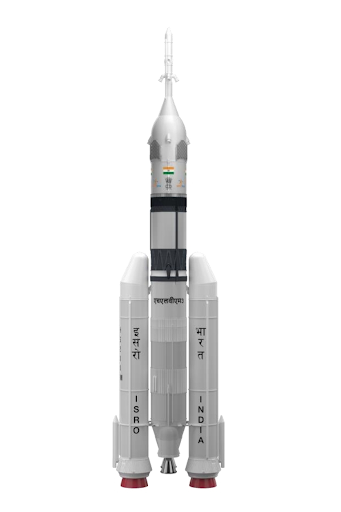
The crew members will fly on a modified version of ISRO’s trusted rocket LVM3 known as Human-Rated Launch Vehicle Mark III (HLVM3). This special modification is to entrust strict human safety standards.
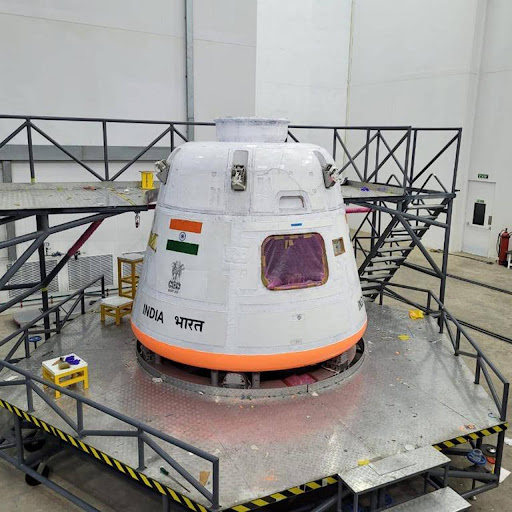
The Crew Module in the spacecraft will be the astronauts’ living space. It is designed to create and maintain an Earth-like environment. This Crew Module, when it re-enters the Earth’s atmosphere, will travel at an extremely high speed and that might create instability.
ISRO conducts years of testing to eliminate the risks of failure. Each test practices different mission scenarios, which also include emergencies.
Returning to Earth safely is one of the most important and dangerous parts. This is where the parachute deceleration system comes into picture and becomes important. The recent Drogue Parachute Drop Test was focused on this dangerous part of the mission; the descent after re-entering in the atmosphere.
Role of Parachute in Coming Home:
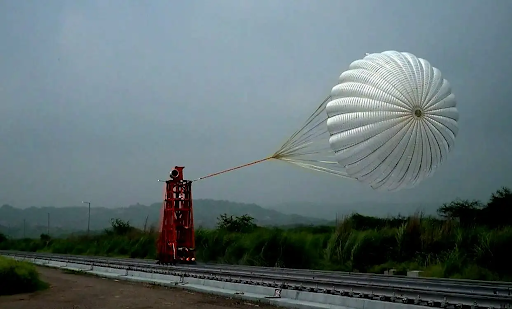
The Gaganyaan Crew Module uses a complex system of four different types of parachutes to help deploy the astronauts safely. The Drogue Parachute is the first parachute to deploy. It plays the role of stabilising the module and reducing its speed.
On December 20, 2025, ISRO announced the successful completion of a critical series of drogue parachute qualification tests, which was conducted on 18-19 December. To test this, ISRO used a high-speed rocket sled at the Rail Track Sled Facility at Terminal Ballistics Research Laboratory (TBRL) in Chandigarh. The successful completion of this test confirms that the module can withstand extreme conditions. It represents a major safety checkpoint in India’s human spaceflight Programme. The tests were conducted with active support from Vikram Sarabhai Space Centre (VSSC), Aerial Delivery Research and Development Establishment (ADRDE), DRDO, and TBRL, reflecting the collaborative effort.
Earlier in November, the main parachutes were successfully tested during the Integrated Main Parachute Airdrop Tests (IMAT). In these tests, the module was exposed to very tough conditions to see how well the parachutes perform. The main parachutes open in stages through a process called reefed inflation. This means the parachute opens partially at first and then fully opens after a set time using small explosive devices. The system is also very safe because it has backup support, that is, only two out of the three main parachutes are needed for a safe landing.
The Road Ahead
With parachute qualification progressing successfully, ISRO moves closer to integrated crew module tests and uncrewed demonstration missions. Each successful test quietly strengthens India’s readiness to join a selected group of nations capable of independent human spaceflight.
Sometimes, a safe landing tells a more powerful story than a spectacular launch.
—
If you like the blog, enrol your school or yourself (k-12 student) in our School Programs or Online Programs, call us at +91-74020 74020 or write to us for any query: getintouch@space-india.com
