
The landscape of Indian education is undergoing its most significant transformation in decades. As the National Education Policy (NEP) 2020 moves from vision to implementation, the shift toward hands-on, inquiry-based learning has become the gold standard.
For CBSE-affiliated schools, there is a crucial milestone on the horizon: August 2027. By this time, the integration of advanced scientific infrastructure will not just be a mark of excellence—it will be a necessity for institutional growth and compliance.
The Shift Beyond Traditional Labs
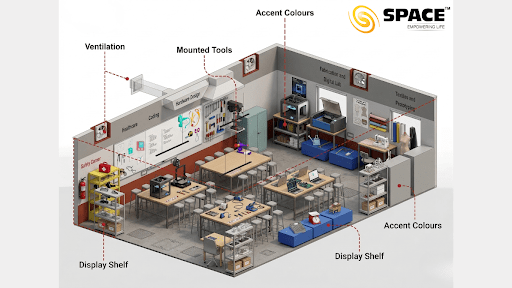
Traditionally, school labs were confined to the “Big Three”: Physics, Chemistry, and Biology. However, the modern world demands a Composite Lab approach—a multidisciplinary space where students can explore the intersections of electronics, robotics, and most importantly, Space Science and Astronomy.
Space science is the ultimate “hook” for student engagement. It combines complex physics with the wonder of discovery, making it the perfect vehicle for teaching the 21st-century skills CBSE now mandates.
Why the August 2027 Deadline Matters
While 2027 may seem distant, the cycle of academic planning, infrastructure development, and teacher training requires immediate action.
- NEP 2020 Alignment: The government’s focus on “Khagolshala” (Astronomy Labs) and Atal Tinkering Labs (ATL) is a clear signal. Schools that wait until the last minute risk falling behind in accreditation standards and educational outcomes.
- Future-Proofing Admissions: Parents are increasingly looking for schools that provide global-standard facilities. A state-of-the-art SPACE Lab is a powerful statement of a school’s commitment to future-ready education.
- Global Space Race: With India’s recent triumphs in missions like Chandrayaan and Aditya-L1, the demand for space education has skyrocketed. Schools have a window of opportunity to nurture the next generation of ISRO and NASA scientists before the curriculum enters a mandatory overhaul phase.
The SPACE India Advantage: 2.5 Decades of Excellence
In a domain where many organisations are new entrants, SPACE India stands as the pioneer. For over 25 years, we have been the only long-running organisation dedicated to bringing the universe into the classroom.
We don’t just “install equipment.” We build ecosystems. A SPACE India Composite Lab includes:
- Professional Grade Instrumentation: High-end telescopes, solar filters, and lunar maps.
- Curriculum Integration: Mapping astronomical concepts to existing CBSE syllabi for Grades 6 through 12.
- Sustainability: Systems designed to last decades, supported by the longest track record in the industry.
Conclusion: Don’t Just Teach Science—Experience It
The transition toward composite labs is an invitation to move away from rote learning and toward the stars. By 2027, the schools that lead the way will be those that recognised the value of space science early.
Is your school ready to lead the New Space Age? The journey to 2027 starts with a single step into the cosmos.
