
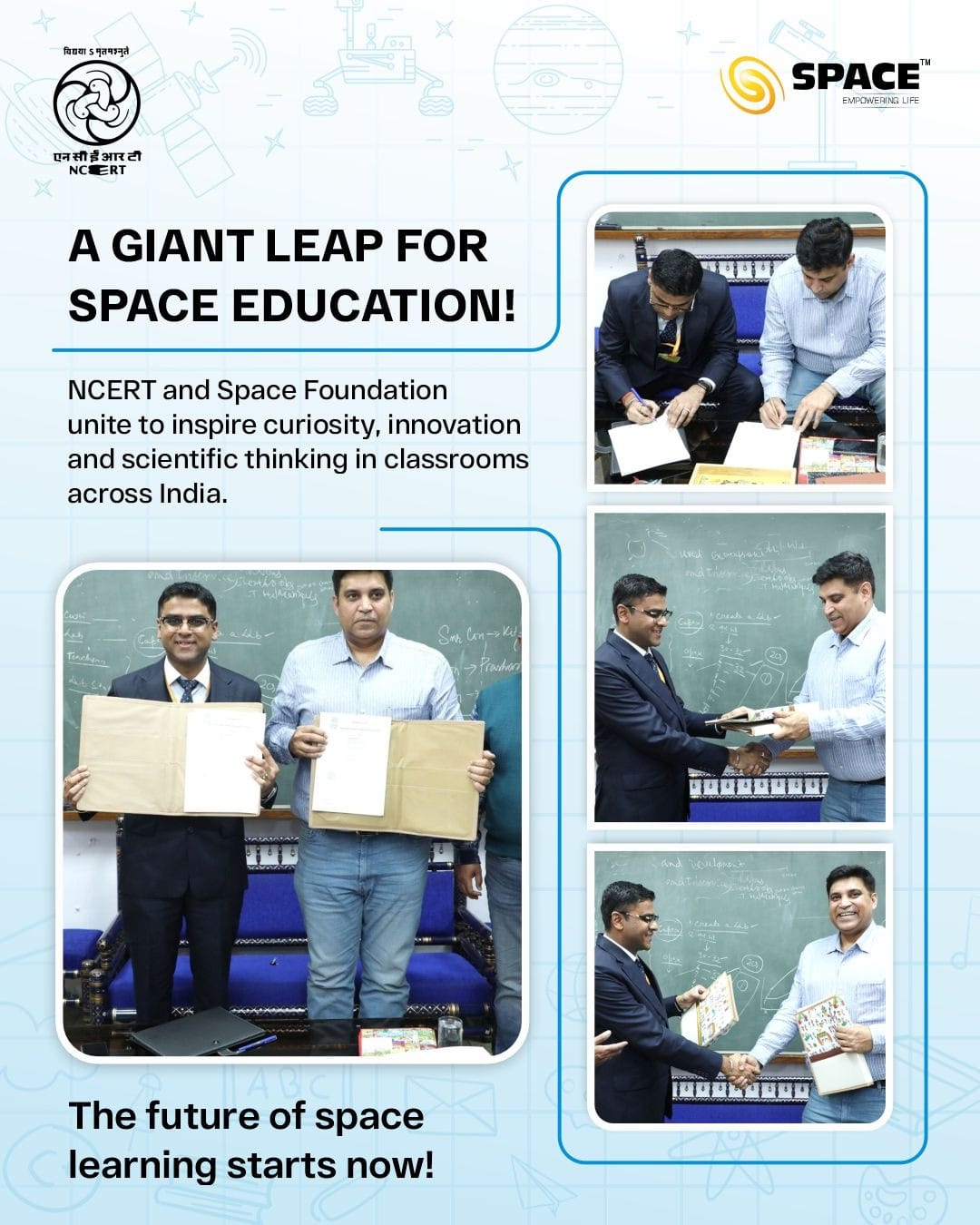
NEW DELHI — In a significant move to align Indian school education with 21st-century scientific advancements, the National Council of Educational Research and Training (NCERT) has officially signed a Memorandum of Understanding (MoU) with the Space Education Foundation.
The three-year collaborative agreement aims to weave astronomy, space education, application, and advanced technology into the educational fabric of schools nationwide, fostering a robust scientific temperament among Indian youth.
Aligning with NEP-2020 and National Curriculum Goals
The partnership is strategically designed to accelerate the goals outlined in the National Education Policy (NEP-2020), as well as the latest National Curriculum Frameworks (NCF-FS-2022 and NCF-SE-2023).
By bringing specialized space education out of the periphery and into mainstream learning, the initiative aims to build critical scientific skills and inspire the next generation of researchers and innovators.
According to the official MoU, the collaboration will focus heavily on content development, collaborative learning, and the integration of modern technology into the classroom environment.
Five Pillars of the Space Education Initiative
The joint initiative between the national educational body and the West Delhi-based foundation will operate across several high-impact areas:
- Digital & Physical Content Creation: The co-creation of specialized educational and training resources tailored for students at various learning levels.
- Teacher Training (CPD): Comprehensive Continuous Professional Development for educators, equipping them to integrate innovative pedagogy and future-ready tech skills into their daily teaching.
- Technological Integration: The implementation of adaptive learning tools, mobile applications, and software to modernize teaching, learning, and assessment.
- Hands-on Scientific Training: Facilitating real-world field training, including the handling of astronomical instruments, scientific observation, and the creation of youth competitions and student internships.
- AI & Collaborative Research: Joint studies utilizing artificial intelligence and machine learning (AI/ML) for big data management, analysis, and interpretation in astronomical research.
Implementation and Quality Control
To maintain the highest standards of national education, NCERT will spearhead the foundational guidelines and Standard Operating Procedures (SOPs). NCERT will also conduct need-based orientation programs to ensure the Space Education Foundation’s contributions seamlessly integrate into major national digital infrastructure, including PMeVidya, DIKSHA, ePathshala, PRASHAST, and the eJaadui Pitara platform.
The Space Education Foundation will shoulder the responsibility of executing the project’s core objectives. The foundation is mandated to ensure that all new methods, materials, and tech solutions strictly adhere to NCERT’s PRAGYATA Guidelines for Digital Education and e-content development frameworks.
Key Delegates at the Signing
The Memorandum of Understanding was officially signed at the NCERT headquarters in New Delhi. The event was graced by senior officials and leadership from both organizations who are committed to the digital and scientific evolution of India’s curriculum.
Representing NCERT was Sh. Himanshu Gupta, Secretary, NCERT, alongside other esteemed administrators. The Space Education Foundation was represented by Dr. Sachin Bahmba, Chairman, Space Foundation, highlighting the foundation’s dedication to making space science accessible to the masses.
A Vision for Bharat 2047: Founder’s Message
At the heart of this partnership is a deeply rooted vision to democratize space education across India. Speaking on the historic collaboration, the leadership of the Space Education Foundation shared their vision for the future:
“Our mission at the Space Education Foundation has always been to bring the universe closer to our students. By partnering with a premier institution like NCERT, we are not just sharing knowledge; we are building a nationwide ecosystem where young minds can dream beyond the sky. This MoU is a stepping stone toward a future where every Indian classroom has the tools to explore astronomy, fostering the next generation of space innovators and scientists.” — Dr. Sachin Bahmba, Chairman, Space Education Foundation
A Voluntary Push for Science
Notably, the MoU is established as a voluntary, mutually beneficial partnership. It imposes no financial commitments on either party, highlighting a shared, public-service-driven passion for elevating India’s educational landscape.
As India’s space sector continues to make global headlines, this grassroots educational push promises to ensure that the nation’s classrooms are preparing students to lead the next frontier of space exploration.
For more information on participating in these new educational initiatives, schools and educators can explore the Space Education programs.
